

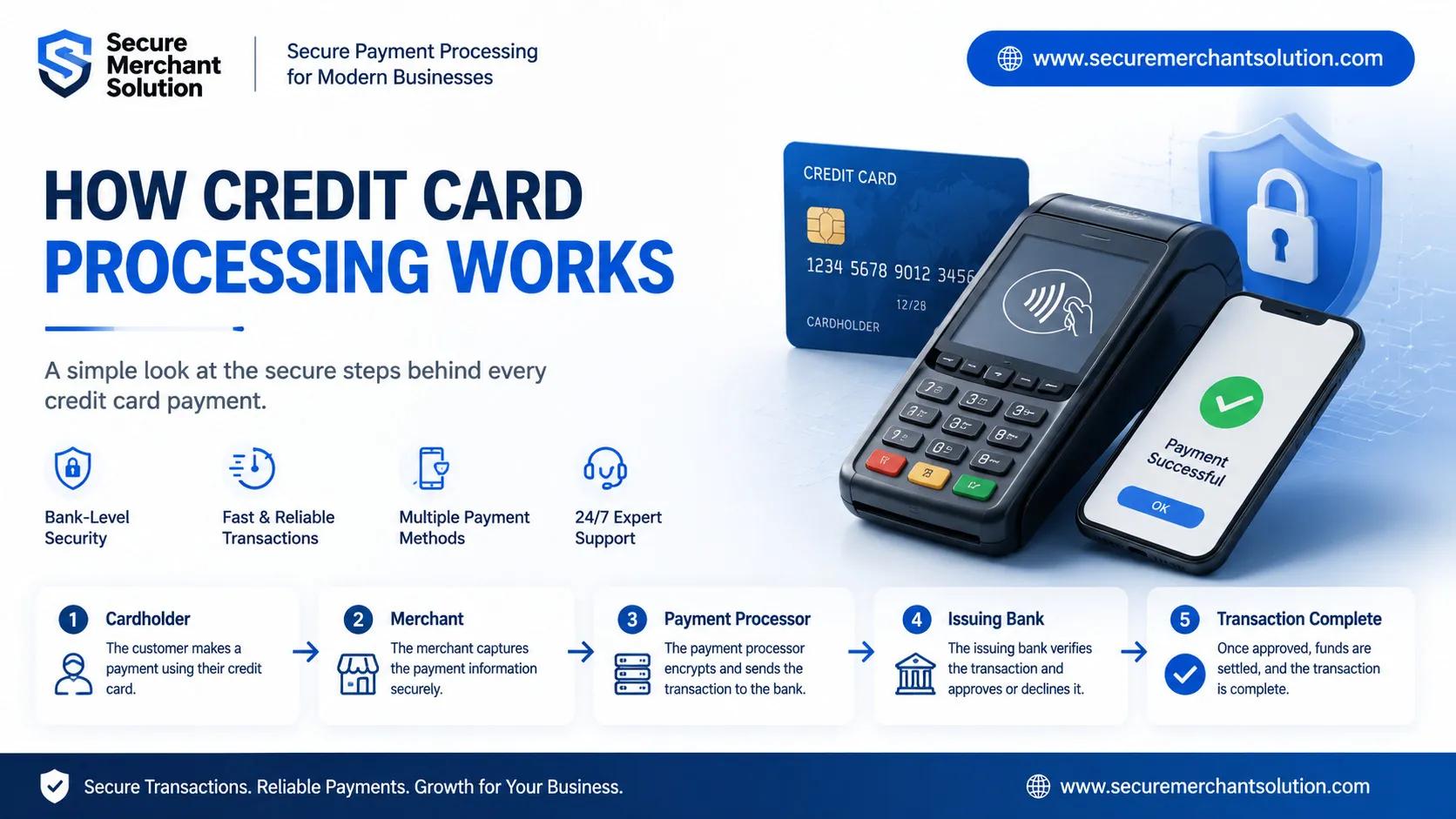
Every time a customer pays with a card, a complex electronic system springs into action. Understanding how credit card processing works is essential for merchants who want secure transactions, predictable costs, and smooth checkout experiences. This guide breaks down the entire process in plain language so you can make smarter payment decisions.
What is credit card processing?
Credit card processing is the technology and network that moves payment information and funds between the customer, their bank, and your business. Within seconds, multiple parties verify the card, approve the charge, and arrange for money to reach your account.bazpay+1
The key players in every credit card transaction
A typical transaction involves six main participants:
Cardholder: The customer using a credit or debit card.
Merchant: Your business accepting the payment.
Payment gateway or terminal: Encrypts and transmits card data securely (online or in-store).
Processor/Acquirer: Routes the transaction and deposits funds into your merchant account.
Card network: Visa, Mastercard, American Express, or Discover that sets rules and moves authorization data.
Issuing bank: The customer's bank that approves or declines based on available credit and fraud checks.bazpay+2
Step-by-step: How a credit card transaction flows
1. Customer initiates payment
The shopper taps, inserts, swipes, or enters card details at checkout—online, via invoice, or at a physical terminal.
2. Authorization request is sent
Your payment gateway or terminal encrypts the card data and sends it to your processor. The processor routes the request through the appropriate card network to the issuing bank.
3. Issuing bank verifies and responds
The bank checks:
Whether the card is valid and not reported stolen.
If the customer has sufficient credit or funds.
Fraud signals like unusual location or spending patterns.
Within milliseconds, the bank approves or declines the transaction.
4. Approval travels back to the merchant
The response moves back through the same path—network to processor to your gateway or terminal. If approved, you complete the sale and capture the payment.
5. Clearing and settlement
At the end of the day (or in real-time for some processors), approved transactions are batched and sent for clearing. The card network coordinates the transfer of funds from issuing banks to your acquiring bank. After deducting fees, the net amount is deposited into your merchant account—usually within 1–3 business days.
Understanding credit card processing fees
Every transaction includes three distinct fee layers. Knowing these helps you read statements and negotiate better rates.
Interchange fees
Paid to the customer's issuing bank.
Set by card networks (Visa, Mastercard, etc.), not your processor.
Typically 1.15%–3.30% plus a small fixed amount, depending on card type and transaction method.
Non-negotiable and makes up roughly 75%–85% of total processing costs.podvector+2
Assessment (network) fees
Paid directly to the card network for using its payment rails.
Usually around 0.13%–0.15% of transaction volume.
Also non-negotiable and separate from interchange.
Processor markup
Your payment provider's service fee.
The only negotiable portion of your total cost.
Can be structured as flat-rate, interchange-plus, or tiered pricing.
Common mistakes merchants make
Avoid these pitfalls to protect your margins and reputation:
Chasing the lowest advertised rate without understanding fee structures or hidden monthly charges.
Ignoring PCI DSS compliance, which can lead to fines, higher fees, or data breaches.
Not reviewing statements to spot downgrades, non-compliance fees, or ineffective pricing models.
Storing card data insecurely instead of using tokenization or hosted checkouts.dynedge+1
Best practices for secure, cost-effective processing
Use end-to-end encryption and tokenization so raw card numbers never touch your systems.
Complete your annual PCI Self-Assessment Questionnaire (SAQ) and keep security habits strong (updated devices, strong passwords, staff training).dynedge+1
Batch transactions daily to speed up settlement and cash flow.
Calculate your effective rate regularly: total fees divided by card sales volume. This reveals your true cost beyond advertised rates.
Consider interchange-plus pricing if you process significant volume—it offers more transparency than flat-rate bundles.
Why Secure Merchant Solution stands out
At Secure Merchant Solution, we combine transparent interchange-plus pricing with enterprise-grade security and dedicated support. Whether you run an online store, a retail shop, or a service business, our team helps you choose the right terminals, gateways, and fee structures so you keep more of every sale.
Why this matters for your business
When you understand how credit card processing works, you can:
Choose the right provider and pricing model.
Reduce unnecessary costs and avoid surprise fees.
Build customer trust with secure, reliable checkout experiences.
Focus on growth instead of payment headaches.
Accepting cards shouldn't be complicated. With the right knowledge and partner, you can turn payments into a competitive advantage—not a cost center.